

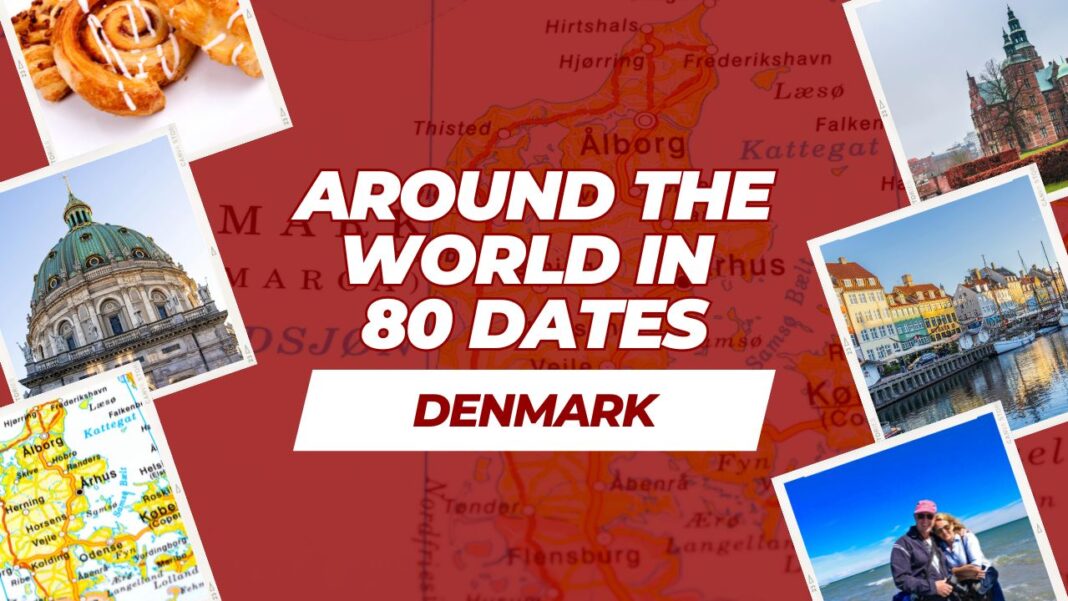
Introduction: Love, the Danish Way
Welcome to Denmark, a country of colourful waterfronts, candlelit cafés, bicycle-filled streets and a famously relaxed approach to enjoying life. Yet behind the postcard views of Copenhagen and the comforting glow of Danish hygge lies a dating culture that can feel refreshingly different from those found elsewhere in Europe.
Dating in Denmark is often shaped by equality, independence, honesty and personal freedom. Grand romantic performances are not necessarily the order of the day. Instead, attraction may develop over a casual drink, a walk beside the harbour, a shared meal or an evening spent talking without pressure or pretence. Danish romance can initially appear understated, but that does not mean it lacks warmth. Affection is simply more likely to be expressed through reliability, companionship and comfortable intimacy than through extravagant declarations.
This makes Denmark a fascinating destination in our Around the World In 80 Dates series. What happens when traditional courtship rules are softened by one of Europe’s most egalitarian social cultures? Who makes the first move? Is a dinner invitation automatically a date, or could it simply be two people enjoying one another’s company? And how do you recognise romantic interest in a society where friendliness, independence and respect for personal space are all highly valued?
Readers exploring the Danish dating scene will discover that relationships are frequently allowed to develop organically rather than ceremonially. There may be no dramatic conversation announcing that two people are officially dating. A couple might begin by meeting socially, spending more time together and gradually becoming an established partnership. This lack of rigid labelling can feel liberating, although newcomers may occasionally wonder where they stand.
- Expect informality: Early meetings are often relaxed rather than elaborately planned.
- Value authenticity: Trying too hard to impress may be less effective than being genuine.
- Respect independence: A close relationship does not necessarily mean surrendering separate interests or friendships.
- Look beyond stereotypes: Danish people are individuals, and experiences vary between cities, generations and communities.
From first introductions and subtle flirting to long-term commitment and family life, dating in Denmark offers an intriguing lesson: romance does not always need spectacle to feel meaningful. Sometimes love begins quietly, grows steadily and becomes strongest when two people can simply be themselves.
Love and Dating Culture
Traditional Danish courtship once reflected the familiar European pattern of community introductions, marriage and family formation. Modern dating, however, is generally much more flexible. People meet through friends, workplaces, universities, sporting clubs, nightlife, social events and dating platforms, with relationships frequently beginning in an informal setting rather than through a clearly defined first date.
One of the most influential features of Danish dating culture is the country’s strong social emphasis on gender equality. There is less expectation that a man must always initiate contact, organise the evening or pay the entire bill. Women may confidently approach someone, suggest meeting or make the first romantic move. Splitting the cost of drinks or dinner is widely compatible with the principle that both people enter the encounter as equals. Of course, one person may still offer to pay, but it should not automatically be interpreted as a compulsory gender role.
This equality can also make Danish flirting appear subtle. Traditional displays of pursuit may be replaced by conversation, shared humour and mutual initiative. Excessive boasting, status signalling or possessiveness is unlikely to create the right impression. Self-confidence is attractive, but arrogance can clash with Denmark’s understated social style. A successful connection is more likely to be built through sincerity, wit, curiosity and respect.
Personal space is equally important. Danish people can seem reserved when meeting strangers, particularly compared with cultures where conversation with unfamiliar people is immediate and highly expressive. This reserve should not automatically be mistaken for coldness or rejection. Trust may take time to develop, but once somebody welcomes a partner into their personal world, the connection can become warm, loyal and deeply comfortable.
Family remains important, but adults commonly exercise substantial independence over whom they date and how their relationships progress. Religion may influence individual families and communities, although Danish dating culture as a whole is generally socially liberal. Cohabitation is familiar and widely accepted, and many couples build committed lives together without treating marriage as the only legitimate measure of seriousness. Marriage may still be meaningful, but it often represents a personal choice rather than an unavoidable social deadline.
- Communication: Honest, straightforward conversation is usually valued more than strategic dating games.
- Gender expectations: Initiative, planning and financial responsibility may be shared.
- Commitment: Relationships can become serious gradually, sometimes without formal labels at the beginning.
- Public behaviour: Affection is accepted, although performative or excessive displays may feel out of step with the understated culture.
- Inclusivity: Denmark has a broadly progressive environment for LGBTQ+ dating and relationships.
The essential etiquette is therefore simple: arrive on time, be genuine, respect boundaries and avoid assuming that old-fashioned courtship rules will apply. Danish dating may not always arrive wrapped in roses and dramatic declarations. More often, it develops through equality, companionship and the quiet pleasure of feeling completely at ease with another person.
Romantic Hotspots & Traditions
Denmark does romance particularly well when it is allowed to feel natural. Rather than building every date around an extravagant dinner or an elaborate declaration, Danish couples often make the most of beautiful surroundings, good conversation and an activity that gives both people room to relax. Fortunately, the country offers an abundance of places where that kind of connection can flourish.
Copenhagen by Candlelight and Canal
In Copenhagen, Nyhavn is an obvious starting point. Its brightly painted townhouses, old wooden boats and waterside cafés create one of Denmark’s most recognisable scenes. You could share a coffee beside the canal, take a boat trip through the city or simply walk along the waterfront while deciding where the evening should lead. It may attract plenty of visitors, but there is still something undeniably romantic about watching the light fade across the water.
For a date with a little more theatre, Tivoli Gardens brings together flower gardens, amusement rides, restaurants, live entertainment and thousands of glowing lights. You do not need to be an enthusiastic thrill seeker to enjoy it. Wandering between the gardens, stopping for something sweet and watching the park illuminate after dark can make even an early date feel memorable. During the Christmas season, Tivoli becomes especially atmospheric, with fragrant fir trees, festive stalls, warming drinks and sparkling decorations creating a storybook setting.
Summer opens up another side of Danish romance. Copenhagen’s harbour baths and waterfront spaces, including Islands Brygge, invite couples to swim, picnic or sit beside the water with food and drinks. Elsewhere, a walk along the beach, a bicycle ride through the countryside or an afternoon exploring a street market can feel more authentically Danish than a formal restaurant reservation.
Beyond the Capital
Do not assume that Denmark’s romantic life begins and ends in Copenhagen. Aarhus offers intimate cafés, the characterful streets of the Latin Quarter, nearby forests and beaches, making it easy to move from city culture to coastal scenery in a single day. Smaller towns and islands provide an even gentler pace, with harbour walks, historic streets and quiet restaurants offering space to talk without feeling rushed.
Seasonal events can also provide the perfect background for romance. Sankt Hans Aften, celebrated on 23 June, brings people together around bonfires, speeches and traditional singing. Christmas markets offer another distinctly Danish experience, particularly when explored with a cup of hot gløgg in hand. These occasions are not dating rituals in themselves, but they create the communal warmth and comfortable atmosphere in which relationships often grow.
From Thoughtful Gestures to Wedding Waltzes
Gift giving in Danish relationships is generally best approached with thoughtfulness rather than unnecessary extravagance. A favourite book, flowers, a carefully chosen bottle of wine or something connected to a shared joke may feel more personal than an expensive display intended to impress. The same principle often applies to proposals. There is no single script that every couple follows, and many partners choose a private, meaningful moment over a highly public performance.
Danish weddings, however, can become wonderfully lively. One of the best known traditions is the brudevals, or bridal waltz, which the newlyweds traditionally perform before midnight. Guests form a circle around the couple and gradually move closer as they dance. At some celebrations, guests may also encourage repeated kisses by tapping glasses or stamping their feet. The result is affectionate, playful and communal, reflecting a culture in which romance may be understated during courtship but enthusiastically celebrated once family and friends gather together.
Online Dating in Denmark
Online dating has become a familiar part of romantic life in Denmark, particularly among younger adults. Research connected with the University of Copenhagen has described a substantial rise in Danish online dating over the past decade, with digital platforms becoming a central feature of how many people in the country search for intimacy and relationships.
The Apps Danish Singles Are Using
Tinder remains one of the most prominent dating apps in Denmark, offering the large and varied user base that often makes it the first stop for singles testing the digital dating scene. Hinge has also established a visible presence, particularly among people who prefer profiles containing prompts, written answers and more material for starting a meaningful conversation. Bumble is another recognised option, giving users access to a broad international platform while promoting a more deliberate approach to making connections.
The distinction between apps should not be treated too rigidly. You can find long term partners on Tinder, casual daters on Hinge and every possible intention in between. What matters is how clearly you present yourself and whether your profile gives another person something genuine to respond to. A few well chosen photographs and a specific, natural description will usually say more than a collection of polished images accompanied by almost no information.
From Matching to Meeting
Technology suits Denmark’s informal dating culture because it allows two people to establish interest without surrounding the encounter with too much ceremony. A match might lead to a brief exchange of messages followed by coffee, a beer, a walk or another simple meeting. This can be an advantage for anyone who finds heavily structured first dates uncomfortable. The emphasis is often on discovering whether conversation flows in person rather than creating an impressive production beforehand.
That informality can also create uncertainty. A friendly meeting may not always be clearly labelled as a date, while a relaxed conversation does not necessarily reveal whether somebody wants a relationship, something casual or simply a pleasant evening. Newcomers may therefore benefit from being straightforward without becoming intense. Asking what someone is looking for can prevent weeks of confusion, and in a culture that generally appreciates honest communication, respectful clarity is unlikely to be considered a serious social mistake.
Location can shape the experience as well. Singles in Copenhagen and Aarhus are likely to encounter a wider variety of nearby profiles, including international residents and visitors. In smaller towns and more rural areas, the available dating pool may feel narrower, encouraging users to increase their search radius or speak to people living farther away. Denmark’s efficient transport links can help, although distance still matters when two people are trying to turn regular messages into a workable relationship.
The Advantages and Frustrations of Digital Dating
One advantage of online dating in Denmark is that it can make introductions easier in a society where strangers may not always begin conversations spontaneously. An app removes some of the ambiguity because both people know that romantic interest is at least possible. It can also help newcomers, expatriates and LGBTQ+ daters find compatible people beyond their immediate social circles.
The familiar disadvantages remain. Endless swiping can encourage quick judgements, promising conversations can disappear without explanation, and having access to more profiles does not always produce deeper connections. Dating fatigue is real, especially when interactions begin to feel repetitive. The best approach is usually to treat the app as a route to a real meeting rather than a substitute for one. Keep early conversations engaging but reasonably brief, check that your expectations are compatible and suggest meeting in a safe public place when the timing feels right.
Digital dating in Denmark ultimately reflects the wider culture surrounding it. It is relatively informal, often direct and shaped by equality and personal independence. You may begin with a swipe on a screen, but the connection is far more likely to grow over coffee, a cycle through the city or an unhurried walk beside the water.
Key Dating Phrases in Denmark
You can travel through much of Denmark using English without encountering serious communication difficulties, but learning a few words of Danish can still transform an ordinary interaction into something warmer. Even a simple greeting shows curiosity about the person and the culture around you. Your pronunciation may not be perfect at first, but making the effort can be charming in its own right.
Begin with a Relaxed Greeting
The easiest Danish word to remember is “Hej”, meaning “Hi” or “Hello”. It sounds close to the English word “hi”, which makes it a wonderfully safe opening. Danish social interaction is generally informal, so you rarely need an elaborate greeting when meeting someone for coffee or arriving at a bar.
Once the conversation begins, try “Hvordan går det?”, meaning “How is it going?” Alternatively, “Det er rart at møde dig” means “It is nice to meet you”. Both phrases are friendly without sounding excessively formal, which fits comfortably with Denmark’s understated dating culture.
Offer a Compliment Without Overdoing It
Danish flirting often works best when it feels sincere rather than rehearsed. “Du har et dejligt smil” means “You have a lovely smile”, while “Jeg kan godt lide din stil” translates as “I like your style”. These are useful compliments because they are warm, specific and relatively easy to deliver without making the other person feel as though they have wandered into an audition for a romantic film.
Tone matters as much as vocabulary. Say the compliment naturally and then continue the conversation. Repeating several flattering phrases in quick succession may seem less genuine, particularly in a culture where restraint and authenticity are often appreciated.
Ask for the Date
When you are ready to suggest meeting, “Har du lyst til at tage en kop kaffe?” means “Would you like to have a coffee?” This is an especially useful invitation in Denmark because coffee offers an informal, low pressure way to get acquainted. It does not demand an entire evening, yet it can easily become a longer date when the conversation is going well.
For something more direct, say “Har du lyst til at gå på date med mig?”, meaning “Would you like to go on a date with me?” Danish speakers commonly use the borrowed word “date”, so the phrase should be readily understood. You could also ask “Er du ledig i weekenden?”, which means “Are you free this weekend?”
When the Date Is Going Well
One of the most useful words in any Danish dating conversation is “hyggeligt”. It relates to the celebrated idea of hygge, although its meaning in conversation can range from cosy and pleasant to simply having a lovely time. At the end of a successful evening, you might say “Jeg har haft det rigtig hyggeligt”, meaning “I have had a really nice time”. This sounds natural, affectionate and entirely appropriate after a first date.
To make your intentions clearer, try “Skal vi ses igen?”, meaning “Shall we see each other again?” There is little need to play an elaborate waiting game if you enjoyed yourself. Danish communication can be direct, and a simple question may be far more effective than spending three days analysing punctuation in a text message.
As feelings develop, “Jeg kan godt lide dig” means “I like you”, while “Jeg er vild med dig” expresses something stronger, closer to “I am really into you” or “I am crazy about you”. Save “Jeg elsker dig”, meaning “I love you”, for the moment when you genuinely mean it. Danish romance may be relaxed, but those three words still carry weight.
Finally, “Tak for i aften” means “Thank you for this evening”, and “Vi ses” means “See you”. Combine them after a good date and you have a warm, uncomplicated farewell that leaves the door open for whatever comes next.
Celebrity Danish Couples
Denmark’s most recognisable love stories often share a quality found throughout the country’s dating culture. The spectacle may be public, but the relationship itself is usually presented through partnership, shared responsibility and the ability to remain grounded. Few couples illustrate that contrast more clearly than King Frederik X and Queen Mary.
King Frederik X and Queen Mary: A Modern Royal Romance
Their story has almost everything required of a contemporary fairytale, although its beginning was remarkably ordinary. Frederik, then Crown Prince of Denmark, met Australian born Mary Donaldson at a Sydney bar during the 2000 Olympic Games. Mary reportedly did not initially realise that the man introducing himself as “Fred” was the future King of Denmark.
That chance encounter developed into a relationship across continents. Mary eventually moved to Denmark, learned Danish and prepared for a life unlike anything she had previously known. The couple married at Copenhagen Cathedral on 14 May 2004, with celebrations continuing at Fredensborg Palace. When Frederik succeeded to the throne in January 2024, they became Denmark’s King and Queen.
The romance captured attention because it seemed to bring the monarchy into the modern world. Mary was not born into European royalty. She had an established professional life in Australia and met Frederik in a social setting that could have produced nothing more than a pleasant conversation. Their story therefore retains a sense of possibility. It suggests that even institutions built on tradition can be reshaped by an unexpected meeting between two people from entirely different backgrounds.
Their partnership also reflects Denmark’s international outlook. Mary had to adapt to a new language, country and public role, while Frederik gained a partner whose perspective extended well beyond royal circles. Their relationship has consequently become more than a romantic narrative. It represents cultural exchange, personal reinvention and the work involved in building a shared life when two backgrounds do not automatically fit together.
For modern daters, the appealing part of their story is not simply that an Australian professional married a future king. It is the reminder that meaningful relationships sometimes begin before either person understands where the meeting might lead. A casual evening, an unfamiliar city and an ordinary introduction can still change the entire direction of a life.
Mads Mikkelsen and Hanne Jacobsen: Partnership Before Fame
For a very different portrait of Danish love, look to actor Mads Mikkelsen and choreographer Hanne Jacobsen. Long before Mikkelsen became internationally recognised through major films and television productions, the pair met through Denmark’s dance world. They have reportedly been together since 1987 and married in 2000, building a family and a long partnership that predates his global celebrity.
Their story offers a quieter alternative to the carefully packaged romances often associated with famous actors. Both came from creative, performance based backgrounds, and Jacobsen had her own professional identity as a dancer and choreographer. Their relationship was therefore established before international premieres, Hollywood roles and red carpet attention became part of everyday life.
They occasionally appear together at major events, but their marriage has generally remained less public than Mikkelsen’s career. That separation between public achievement and private life feels distinctly compatible with Denmark’s preference for understatement. Fame may attract attention, but it does not have to become the organising principle of a relationship.
Placed alongside Frederik and Mary, Mikkelsen and Jacobsen reveal two sides of Danish romance. One couple lives at the centre of a historic monarchy, while the other moves between Danish cultural life and international cinema. Yet both stories place considerable value on longevity, individuality and companionship. Neither relationship is compelling merely because the people involved are famous. They remain interesting because they suggest that love survives through adjustment, mutual respect and the life two people construct away from the audience.
That may be the most Danish lesson of all. Romance can begin dramatically or almost by accident, but lasting love is usually found in the quieter moments that follow. It is built when two independent people continue choosing to face life together, long after the first excitement has settled into something deeper.
Lessons for Love
Denmark’s dating culture offers a useful reminder that successful relationships do not always begin with dramatic gestures, perfectly planned evenings or instant certainty. Often, the strongest connections grow from something much simpler: two people feeling comfortable enough to be honest, curious and fully themselves.
One of the clearest lessons is the importance of meeting as equals. Danish dating culture tends to place less emphasis on rigid ideas about who should make the first move, who should organise the date or who should pay. That does not mean generosity has disappeared. It simply means that both people are encouraged to participate in creating the relationship. You can apply this wherever you live by showing initiative, sharing responsibility and avoiding assumptions based purely on gender or outdated dating rules.
Let the Connection Breathe
Another valuable lesson is that romance does not need to be forced into a timetable. In Denmark, a relationship may develop gradually through coffee, shared activities, mutual friends and repeated time together. There may not always be a grand announcement that two people are now officially dating. For anyone accustomed to searching for immediate certainty, this can feel unfamiliar, but it can also be freeing.
Allowing a relationship to breathe gives you time to notice what really matters. Do you enjoy one another’s company when there is no elaborate entertainment? Can you communicate naturally? Do you respect each other’s independence? Excitement is important, but the ability to feel at ease together is often a better indicator of long term compatibility.
This does not mean you should tolerate endless ambiguity. There is a difference between allowing feelings to develop naturally and remaining trapped in confusion. Denmark’s appreciation for direct communication offers the answer. When you need clarity, ask for it calmly. A sincere conversation about intentions is healthier than trying to interpret every delayed reply, shortened message or unexplained change in tone.
Choose Authenticity Over Performance
Danish culture also teaches us to be cautious about turning dating into a performance. It is tempting to present an idealised version of yourself, particularly online, but maintaining that image becomes exhausting. A carefully staged personality may attract attention, yet genuine compatibility depends on being known as you really are.
This is where the Danish preference for understatement becomes especially valuable. You do not need to dominate the conversation, advertise every achievement or manufacture mystery to appear desirable. Listening well, asking thoughtful questions and showing a quiet sense of confidence can be far more attractive. The goal is not to impress everyone. It is to connect with someone who appreciates your actual character.
Exploring dating cultures beyond our own helps challenge the idea that there is only one correct way to find love. Some societies favour formal courtship, while others allow romance to emerge from friendship. Some value expressive declarations, while others communicate affection through consistency and practical care. Seeing these differences can make you more adaptable, less judgemental and more open to people whose romantic language may not immediately resemble your own.
The universal lesson is that love thrives when both people feel respected, understood and free to contribute. Whether you are dating in Copenhagen, Cardiff or anywhere else in the world, equality, honesty and genuine companionship provide a strong foundation on which something lasting can be built.
Conclusion: Finding Warmth in the Danish Way
Dating in Denmark may appear understated at first, but beneath its relaxed surface lies a thoughtful and deeply appealing approach to relationships. It is a culture in which affection does not always need to announce itself loudly. Love may arrive during an unhurried cup of coffee, a bicycle ride through the city, a candlelit evening at home or a quiet walk beside the harbour.
What makes the Danish approach special is its combination of independence and togetherness. Partners are encouraged to maintain their own identities while creating a shared life. Initiative can come from either person. Responsibilities can be divided rather than assigned according to tradition. Romance is not treated as a contest in which one person pursues while the other waits to be impressed. At its best, it becomes a collaboration.
This spirit can be reassuring for both new and experienced daters. You do not have to follow a complicated rulebook or create an extravagant impression. You can begin with an honest conversation, a simple invitation and a willingness to discover who the other person really is. Denmark reminds us that an enjoyable date is not defined by how much money was spent or how carefully every moment was staged. It is defined by how two people felt in each other’s company.
Take the Best of Denmark With You
You do not need to move to Copenhagen or master the Danish language to learn from its dating culture. You can bring a little of its relaxed confidence into your own romantic life. Suggest the date rather than waiting indefinitely. Choose an activity that allows genuine conversation. Be open about your interest without overwhelming the other person. Respect their independence, but do not confuse emotional distance with strength.
You can also borrow the spirit of hygge by creating dates that feel warm, comfortable and personal. A meal cooked together, a favourite local café or an evening spent talking without constant distractions can reveal far more than an expensive experience designed primarily for photographs. The setting matters, but the quality of attention you give one another matters more.
At Online Dating UK, we believe that exploring how people connect around the world can help us become more thoughtful daters at home. Every culture brings its own expectations, rituals and romantic vocabulary, yet the desire beneath them remains familiar. People want to feel valued. They want to be chosen honestly, treated with kindness and understood without having to surrender who they are.
Denmark shows us that love can be calm without being dull, independent without being distant and simple without being insignificant. The gestures may differ from one country to another, but the hope behind them is universal. Somewhere between the first greeting and the moment two people decide to build a future together, love finds a language of its own.
Ready to begin your own story? Join Online Dating UK and start meeting new people today.